Logicard
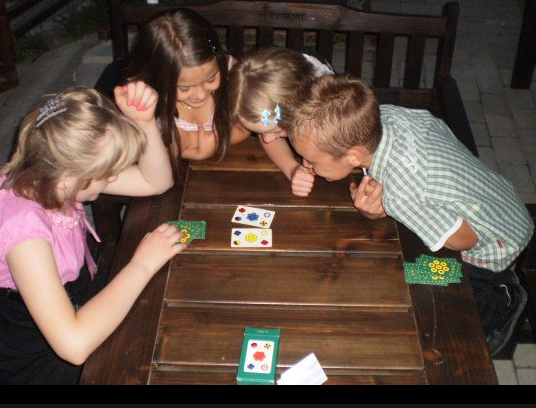
… is a card game with seven symbols in three colours on 21 cards, each card having one large and four small symbols. A distinct characteristic of the game is that on any two cards you will find one (and only one) symbol of identical form and colour. The symbols are numbered from 1-7, and their number corresponds to their form.
It was created by the Hungarian inventor JÉGER József – Joseph JAEGER if you are into translating names :)

The innovative construction of LOGICARD© allows to play unique new games involving memory, speed, tactics, combination and logic. The cards are suitable for some traditional card games too. The game provides challenging entertainment for all ages from around 5. Playing develops attention, memory, combination and various other quite useful human cognitive functions.
The possible games are still under development, but here are the three most popular so far:
LOGICARD REFLEX (for 2-8 players)
The dealer shuffles the deck and places the top two cards face-up on the table. By the way, the dealer can also take part of the game according to the number of players. There will be one and only one symbol of the same form and colour that is on both cards. If the two identical symbols are both small, the task of the players is to say (shout, scream, mumble, whisper audibly) the number of the twin symbol, like this: 'Five!' But if one card has a small symbol in a corner and the other card has a large version of the same shape and colour in the middle, the task is to stay silent and point to the large symbol. The task of the players is to point to the figure which appears on both cards and the colour of which is identical, i.e. the figure must match in both form and colour. If one of the identical figures is a large figure located in the centre of the card, then the player must point to the larger figure. Whichever player first points correctly to the symbol of identical form and colour which appears on both cards in the corner, or correctly points to the larger figure in the centre of the card, wins both cards. If a player makes a mistake, however, (such as: pointing to an incorrect symbol, calling a number instead of pointing to a symbol, etc.) then all cards won thus far by that player must be returned to the dealer, who then places them at the bottom of the dealer’s deck. The dealer may also take part in the game. The dealer rules in any debate.
JAEGER POKER (after the inventor, József Jéger – 2-6 players)
The dealer shuffles the deck, deals 3 cards to each player, and then lays out a further 3 cards side by side on the table face-up. The additional cards (in case of less than 6 players) remain in the pack. The goal of the game is to obtain the most groups of 3 cards of the highest value. The dealer begins with the player at his/her left and continues clockwise. The next player in line may either change their hand by discarding an unwanted card and being dealt a new one, or he/she may pass. The first player to pass (i.e. not exchanging a card) begins the last round of the game. The player to the right of the first player to pass may exchange cards for the last time in the round. At the end of the round all the players reveal their hands by placing their cards face-up on the table, after which the cards are evaluated. The winning player is the one with the most valuable three-card hand. The value of the three card hands:
- Poker: 3 of a kind, one large figure (in the centre), e.g. 3 cards with a barrel in the centre of each card (5);
- Large row: 1 large (centre) and 2 small (corner) figure of the same colour and form. E.g.: 1 large (centre) and 2 small (corner) red barrel;
- Small row: 3 of a kind of a small symbol (corner), e.g. 3 small red barrels (corner);
- Large pair: 1 large (centre) and 1 small (corner) symbol of identical colour and form, e.g. 1 large and 1 small red barrel;
- Small pair: 2 symbols (corner) of identical colour and form, e.g. 2 small red barrels;
The value of the categories listed above is determined first by the value of the symbol (the number above the symbol) and second by its colour (the highest value is red, the middle value yellow, and the lowest blue).
LOGICARD SUDOKU (a game played solitarily)
The player shuffles the deck and puts aside a card chosen at random. The objective of the game is to arrange 20 cards in a grid of 5x4, in which no symbol of identical colour and form may appear in a row or column. (The rows and the columns are to be arranged side to side – 8x10 cards – and below one another - 10x8.) The game begins by the player placing two cards twice on the table, with the condition that the small symbols in the corners of the cards appear only once in each row and column. Once this is accomplished a further five cards may be placed by the four already on the table so that they form a three-card by three-card square; this is followed by a four-card four-square, then a four-card five-square.
Ordering Logicard
- we ship worldwide
- please send an email to richard at oakmind dot com with your address